Moodle activity · Hosted courses · Printed decks
Turn any dataset into a card battle.
Market capitalisations, melting points, grams of CO₂ per kilometre. Card Clash deals your data as playing cards and lets learners duel with it — round after round, until the numbers stop being abstract.
The problem
Nobody remembers a number they only read once.
Ask a class how much a blue whale weighs, what a company is worth, or how much CO₂ a short-haul flight costs per passenger, and you get guesses that are wrong by a factor of a thousand. Magnitudes are not learned by reading them. They are learned by comparing them, repeatedly, with something at stake.
A reason to look twice
Every round is a bet. To pick a category the learner has to estimate their own value, guess the opponent’s, and decide. That is three acts of numerical reasoning per card — and it feels like play, not practice.
Magnitudes that stick
After a dozen rounds a learner knows that a cheetah runs three times faster than a person, that gold melts at over a thousand degrees, that a train beats a car by an order of magnitude on emissions. Not memorised — internalised.
Data you can question
Every attribute in every shipped deck is sourced and documented, so “where does this number come from?” is a lesson, not an awkward pause. Building a deck together is itself the exercise.
Play a real game right now.
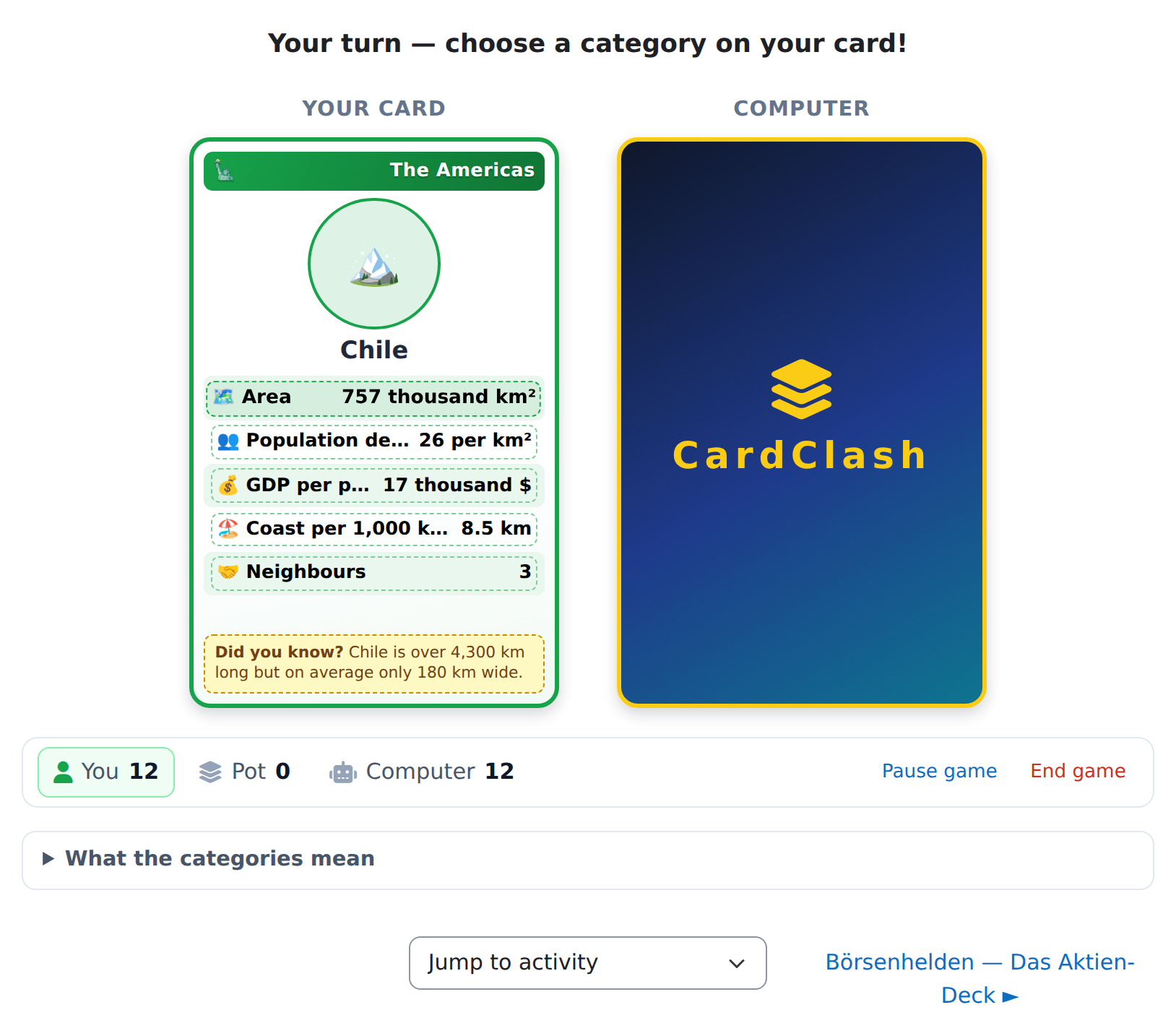
The demo on play.card-clash.io is the actual product, not a mock-up of it — the same engine, the same shipped decks, the same server-resolved rounds. No account, no email, nothing saved.
Set it up in a lesson break.
A teacher picks a deck, sets the difficulty, and shares the link. Everything else — dealing, scoring, grading, reporting — happens on its own.
Pick a deck
Eighteen curated decks in English and German, from garden birds to money traps. Or upload your own spreadsheet — one row per card, one column per attribute.
Set the rules
Three computer difficulty levels, a round limit, how many cards a game uses, and whether learners may draft their own hand before play.
Learners duel
Solo against the Clash Bot, in the browser, on any device. Games can be paused and resumed. The opponent’s card never reaches the browser before the reveal.
See what they missed
Reports show which categories each learner keeps losing and which they avoid altogether — a direct map of where their sense of the data breaks down.
Who it’s for
The same game, from year 2 to the trading floor.
What changes is the deck, not the mechanic. Six-year-olds compare animal weights; risk analysts compare capital ratios. Both are learning to feel the size of a number.
Primary · ages 6+
Number sense, before the numbers get hard
Bigger and smaller, heavier and lighter, faster and slower. Reading a value off a card and comparing it is a complete numeracy exercise, and the cards do the motivating.
🦁 Animals 🥑 Food 💡 Inventions
Secondary & vocational
Subject data that finally has a reason to be compared
Melting points in chemistry, GDP per person in geography, emissions in sustainability class. Drop a deck in at the start of a unit as a diagnostic, or at the end as revision.
⚗️ Elements 🌍 Countries 🚄 Transport
Higher education & libraries
Data and source literacy, played
The media-literacy deck scores kinds of information source — peer-reviewed paper, press release, rumour — on expertise, fact-checking, transparency and reach. Students argue about the scoring, which is exactly the point.
🔍 Source Check 🪐 Astronomy 📊 Your own data
Companies & marketing teams
Your product portfolio, played rather than skimmed
A branded deck about your own range is a marketing channel that customers choose to spend time with — and the same deck onboards new staff into what you sell. Card Clash for Business →
📈 Your KPIs 🖨️ Printed decks 🎯 Customer education
Bring your own data
If it fits in a spreadsheet, it fits on a card.
One row per card, one column per attribute. Upload the CSV, check the preview, import. Card Clash works out the attributes, creates the groups, and tells you exactly which line is wrong if a value does not parse.
- Point or comma decimals, grouped thousands — whatever your spreadsheet exports.
- Mark a category as lower wins for prices, emissions or reaction times.
- Export any deck back to CSV, edit it in Excel, import it again.
- Nothing is written until you confirm the preview.
Five ways to get it
Whether or not you run Moodle.
One is self-serve and takes minutes. The rest are projects we scope with you.
Card Clash for Moodle
You already run Moodle
- The activity plugin, annual subscription
- All eighteen decks, EN & DE
- Grades, completion, reports, backup
- Updates and support included
Hosted courses
You teach, but you don’t run Moodle
- A ready-made course on our Moodle
- Share one link with your group
- Guest access with a password — no accounts
- Hosted and maintained by us
Card Clash Embedded
You have your own platform
- Standalone build, no Moodle needed
- Integrated into your site or product
- Your branding, your data model
- Fixed scope, fixed quote
Deck & didactics support
You know the goal, not the deck
- We help you choose the right data
- Attribute design and balancing
- Fitting it to your curriculum
- From a half-day workshop upwards
Printed card decks
You want it on the table
- Your deck, professionally printed
- Your branding on every card
- Classroom, training room, trade fair
- Works with or without the digital game
Tell us the goal
We’ll tell you which route is cheapest
Most conversations start with “we have this data and this group of learners”. That’s enough to work with.
Built to survive procurement
Playful on the surface. Boring underneath, on purpose.
Results that can’t be faked
Every round is resolved on the server. The opponent’s hidden card never reaches the browser, so a score that feeds a grade cannot be manufactured from the console.
GDPR by construction
Full Moodle Privacy API support: declared metadata, per-user export and deletion. No third-party calls, no trackers, no external fonts on this page either.
Keyboard and screen reader
Category rows are real buttons, round outcomes are announced through a live region, and the interface reflows down to a phone.
Grades and completion
Each finished game scores 0–100. Aggregate as best, average or last, push it to the gradebook, and set completion on games finished or a win.
Backup, restore, reset
Standard Moodle backup and restore including decks. Course reset clears games and keeps the deck. Migrations behave.
Let visitors try it
Demo mode lets guests play a throw-away game that is never saved, graded or tracked — which is exactly what runs on play.card-clash.io.
Questions
Before you ask.
Do we need Moodle to use Card Clash?
To run it yourself, yes — Card Clash is a Moodle activity. If you don’t run Moodle, buy a hosted course from us and share the link; your learners join as guests with a password, with no accounts to create. If you’d rather have it inside your own product, we build a standalone version and integrate it.
Can we use our own data?
Yes, and most customers do after the first lesson. Import a CSV — one row per card, one column per attribute — or build the deck in the editor. You can also export a deck, edit it in a spreadsheet and import it back. If your data needs shaping first, that is what our deck support service is for.
Which languages does it speak?
The interface ships in English and German. Every shipped deck exists in both. Decks you create can be in any language — the deck is just your text and your numbers.
Is it suitable for young children?
From about year 2, with a deck that fits: animals, food, transport. Reading a value and deciding whether it is bigger or smaller is the whole skill. Turn the computer down to Rookie, switch grading off, and let them play.
What do teachers actually see afterwards?
Games played, won, lost and abandoned per learner; the average score by attempt, so you can see a learning curve; and a knowledge-gap report showing which categories a learner keeps choosing and losing — and which they never choose at all. Plus deck balance and per-attribute card ranks for tuning your own decks.
Can we get it printed?
Yes. We take a deck — yours or one of ours — apply your branding and have it produced as a physical card deck for the classroom or training room. Popular as a conference giveaway that people keep. See a worked example.
Where is the data stored?
On your Moodle if you run the plugin, so nothing leaves your infrastructure. On our hosted service if you buy a course there. The plugin makes no outbound network calls and implements the full Moodle Privacy API for export and deletion.
Next step
Bring us a spreadsheet. We’ll bring the cards.
Tell us who is learning and what they should be able to feel by the end. We’ll tell you which route gets you there fastest.